Front
Back
Video
The story
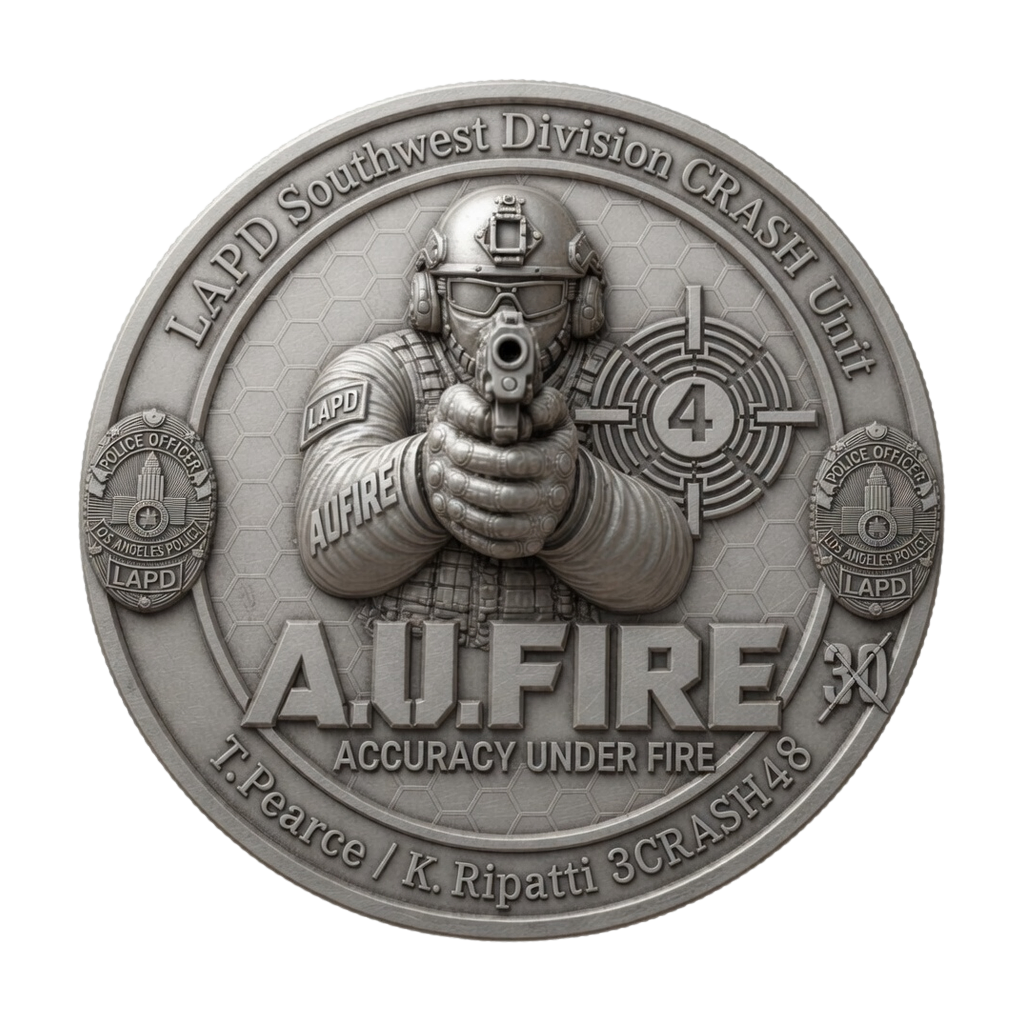
Tim Pearce and the Origin of A.U.FIRE: Turning Tragedy Into Life-Saving Training Some inventions begin in laboratories. Others begin in grief, necessity, and the painful realization that something critical is missing. Accuracy Under Fire — A.U.FIRE — began with Tim Pearce, a veteran Los Angeles Police Department officer who saw, in the most personal way possible, a dangerous gap in police and military training: officers and warfighters are expected to keep fighting after being injured, but almost no one trains them realistically for that moment. Tim Pearce spent 17 years with the LAPD, working in one of the most demanding law enforcement environments in the country. He understood patrol work, violent encounters, and the split-second decisions officers must make under stress. But the moment that changed the direction of his life came on June 3, 2006. Earlier that day, Tim and his wife, LAPD Officer Kristina Ripatti, participated in the LAPD Memorial Run. Later that night, Kristina was on duty when she pursued and confronted a robbery suspect. The suspect turned and shot her multiple times, leaving her permanently paralyzed from the chest down. Tim arrived at the scene and helped triage his wife on the porch as paramedics arrived. That tragedy exposed a brutal truth. Even highly trained officers may experience the shock, pain, physical failure, and cognitive overload of a catastrophic wound for the first time during an actual gunfight. Traditional training could teach marksmanship, tactics, weapons handling, communication, and medical aid. But it did not realistically teach an officer what to do after being hit, losing use of a limb, and still needing to fight back. After Kristina’s injury, Tim watched her physical therapy team use TENS technology to stimulate and contract muscles in her legs to help fight muscle atrophy. That observation became the seed of A.U.FIRE. Tim recognized that the same basic muscle-contracting technology could be adapted into a safe training system — not to injure trainees, but to simulate the sudden loss of limb function caused by a gunshot wound or other debilitating injury. From that idea, Tim developed a system that could be worn by officers or military personnel during force-on-force training. Instead of asking trainees to “pretend” they had been shot, A.U.FIRE creates a real physical consequence. An instructor can remotely activate wearable E-Stim sleeves or garments, causing immediate muscle contraction that temporarily immobilizes an arm, leg, or other body area. When the instructor releases the button, normal function returns. The purpose is not pain. The purpose is preparation. A.U.FIRE trains what Tim often describes as the fight-back mindset: staying mentally in the fight, solving problems, returning accurate fire, communicating, moving, and applying self-aid under intense stress. The system forces trainees to experience the disruption of injury before their worst day arrives. It creates what A.U.FIRE calls “Distraction by Contraction” — a safe but powerful way to train the brain to override panic, hesitation, and the self-preservation instinct. The training gap A.U.FIRE addresses is not theoretical. Military and law enforcement personnel are often expected to continue fighting after injury, whether they are operating alone, in pairs, or in small units without immediate backup or medical evacuation. Operational research prepared for A.U.FIRE notes that Special Operations Forces, Military Police, and Department of the Army Police may be required to maintain security, suppress threats, or continue mission-critical action even after suffering injuries that limit mobility or limb function. Yet traditional injury simulation has often been crude: taping an officer’s arm, telling a trainee they are “wounded,” or having them tuck a hand into a belt. Those methods can teach a concept, but they do not replicate the surprise, stress, physical disruption, and decision-making pressure of being injured while still under attack. A.U.FIRE replaces imagination with consequence. That is why Tim Pearce’s invention matters. A.U.FIRE is not simply a product. It is a response to a question Tim never wanted to have to ask: What if officers could experience the shock of injury in training, instead of learning it for the first time on the street? Today, A.U.FIRE is positioned as a reality-based training system for law enforcement, military, tactical teams, academies, and simulator platforms. It is designed for active shooter response, ambush defense, injured-officer survival, one-handed weapons manipulation, tourniquet application under duress, and decision-making under fire. At its core, the story of Tim Pearce and A.U.FIRE is the story of turning tragedy into preparation. Kristina Ripatti’s shooting revealed a gap that no officer, soldier, agency, or family should ignore. Tim’s response was to build a tool that gives protectors a chance to rehearse their most critical moment before it becomes real. A.U.FIRE exists so that when an officer or warfighter is injured and still under attack, that moment is not unfamiliar. They have been there before. They have felt the disruption. They have practiced the response. They know they can fight back. That is the backstory behind A.U.FIRE: a husband, an officer, and an inventor taking the worst day of his life and turning it into training designed to save someone else’s.
Holders
2Loading holders…